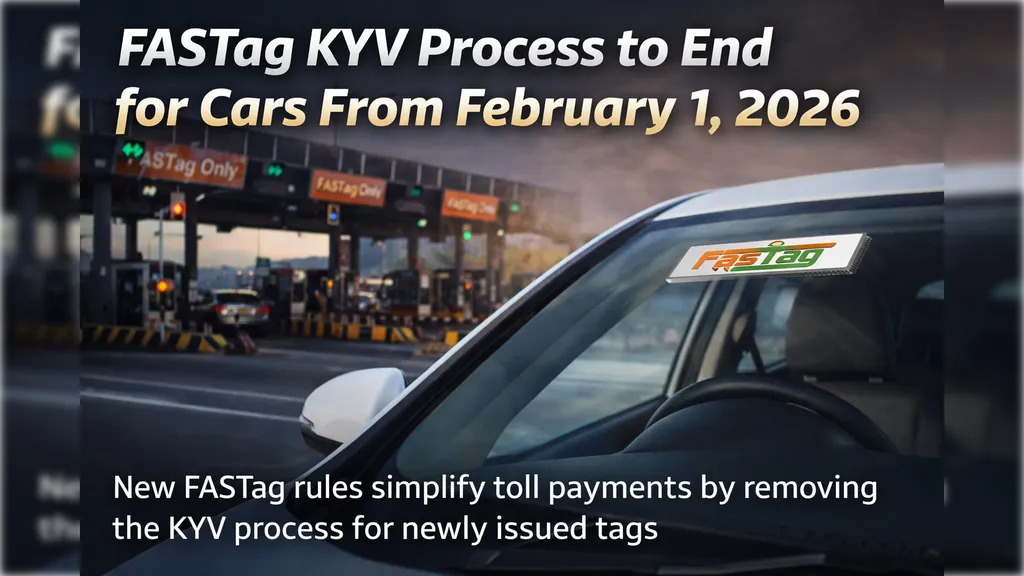
The National Highways Authority of India (NHAI) has announced a significant change in how FASTags are issued for cars, jeeps and vans. From February 1, 2026, the Know Your Vehicle (KYV) process — previously required after a FASTag was activated — will no longer be mandatory for new FASTag issuances. This decision aims to make the FASTag system more user-friendly by eliminating delays and repeated verification steps that drivers often faced.
What Is the KYV Process?
The KYV (Know Your Vehicle) process is a verification step linked to FASTag issuance and usage. It was originally introduced to ensure that the FASTag is correctly linked to the specific vehicle, matching vehicle registration details with the national vehicle database to prevent misuse and duplication. Under the previous system, even after buying and activating a FASTag, users often had to undergo KYV separately, leading to confusion and inconvenience.
What Changes From February 1, 2026?
1. No KYV for New FASTags
• For all new FASTags issued on or after February 1, 2026, KYV verification will not be required as a separate step after activation.
• Instead, all vehicle verification will be completed before activation through online validation against the government’s VAHAN database. Banks issuing FASTags will now be responsible for ensuring this verification is done upfront.
2. Existing FASTag Users Get Relief
• FASTags that were issued before this date will also no longer need routine KYV checks unless there is a specific issue, such as a complaint or suspected misuse.
• This means that many existing users won’t have to revisit the KYV process at all.
How Will Verification Work Now?
Under the revised rules, banks issuing FASTags must verify vehicle information before activation, using the central vehicle database (VAHAN).
If the vehicle details aren’t available in the national database, then the bank must verify them manually using the vehicle registration certificate (RC) before activating the FASTag.
This upfront verification replaces the previous method where tags could be activated first and verified later, which often led to multiple reminders and follow-ups for users
Why NHAI Made This Change
The NHAI’s decision was driven by feedback from highway users who faced repeated compliance checks even after submitting correct documents during FASTag issuance.
Post-activation KYV steps often caused:
- Delayed toll tag activation
- Repeated follow-ups with banks
- Temporary deactivation or service interruptions
- Confusion among vehicle owners
By moving the verification process earlier and tying activation strictly to pre-checked documents, NHAI expects fewer hassles for drivers and better overall FASTag reliability
Benefits for Car Owners
Here’s how this rule change helps everyday drivers:
✔ Faster FASTag Activation — No waiting for KYV after activation.
✔ Less Paperwork — Document checks happen upfront, avoiding multiple uploads.
✔ Fewer Follow-ups — Users won’t be contacted repeatedly for verification.
✔ Better Toll Experience — Less risk of tags being blocked due to KYV delays.
✔ Consistent Protocol — Banks must validate first, meaning fewer surprises later
Are There Any Exceptions?
Yes. While KYV is no longer a routine requirement, it may still be triggered in specific cases, such as when:
- A FASTag is reported as not working correctly
- A tag is suspected to be misused or duplicated
- A tag shows mismatched vehicle details at a toll plaza
In such scenarios, KYV may still be used as a corrective tool to ensure tag integrity.
What This Means for the FASTag Ecosystem
The change marks a shift toward a more streamlined and user-centric system for electronic toll payments in India. FASTag, which uses RFID technology to enable automatic toll deduction at highway plazas, has already become crucial for seamless travel across national highways. Removing the KYV hurdle aligns the process with broader goals of digital convenience and fewer operational bottlenecks.
Conclusion
From February 1, 2026, NHAI’s decision to end the mandatory KYV process for new FASTag issuances will make getting and using FASTags much easier for car owners. By shifting verification to the pre-activation stage, authorities aim to reduce delays, cut down unnecessary follow-ups and improve the overall user experience.
While KYV remains a tool for exceptional cases, its removal from the routine process is a welcome relief for millions of vehicle owners who rely on FASTag for daily travel and long-distance road trips.